 Cover - Thomas Campbell
The Tragedy of Richard the Third is a gripping tale of intrigue, dynastic murder and a fascinating study of evil. Or at least, it can be.
Unfortunately the first half or so of this production is very average indeed, heading towards being boring, but fortunately it picked up considerably as the play entered its latter phases. For some though, the damage may already have been done, with the pedestrian opening dragging along, engendering one’s disinterest to the point that when the staging suddenly becomes a lot more interesting and varied, it almost seems like a glaring disjunction between the work of two different directors. It is an odd shortcoming for this production, and based on her track record we would certainly expect better from the usually excellent Kate Gaul.
Also, the decision to stage this two-hour cut of the text without an interval was rather annoying. If a play is under two hours in duration and/or is an especially taut thriller for which it is important to maintain an unbroken dramatic tension, it is perfectly acceptable to do without an interval. However, this is Richard the Third and we all know how it ends, so the lack of interval seems quite uncalled for, especially given the lacklustre staging of the first half.
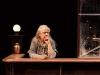
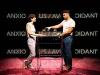
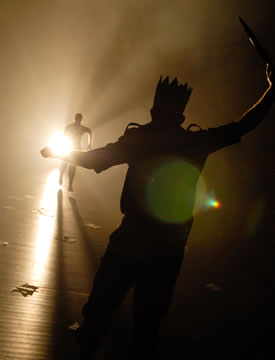
The second part of the production may seem a long time coming, but when it does arrive it is definitely worth sticking around for. Gaul’s staging of the play in a large, unadorned square of bare floor devoid of any kind of set or fixtures creates a versatile, imaginative space without wings or any backstage area. It is a space which comes to be progressively redefined from scene to scene with the gradual inclusion and reorientation of items of simple furniture brought in from the edges of the stage with Brechtian transparency. Similarly, the changes in character, generally signaled by adding or discarding a main costume element, is done openly and in full view of the audience. This open theatrical style works very well and adds an engaging element to the seemingly simple stagecraft, and is a far better way of dealing with the rapid character substitutions among the small cast than by any contrivance of concealing it with token entrances and exits.
Indeed, the cast is unusually small, even for an independent Shakespeare production, with a mere six actors, and given that a single performer is permanently in the title role, all the other parts are divided between the other five hardworking players. It is a talented, mostly quite young cast, predominantly drawn from NIDA graduates from a few years ago, some of whom have stuck together as the company MAKEbeLIVE. Due to the structuring of the roles there is an inevitable sense of distinction between the multiplicity of the performances from those playing several roles, and that of the lone actor playing Richard exclusively, who is thus inevitably thrust into the position of “star.”
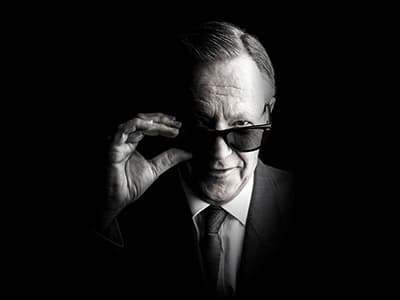
And as that star we have the always intriguing Thomas Campbell. Young, idiosyncratic and in some respects an unconventional choice for this great Shakespeare villain, Campbell does a very strong job with such a challenging character, one famously open to a variety of interpretative approaches. To be blunt, it is certainly not a revelatory performance, but it is most definitely a memorable one, as it builds gradually with an escalating sense of menace and villainy that nicely matches the character’s progression throughout the play. Campbell imbues his Richard with a darkly humorous, faintly camp sensibility that plays to the character’s vanity and capriciousness, dancing the razor’s edge between endearing and repellent.
With a captivating delivery of his many asides and monologues, Campbell is very effective at playing to the crowd and making the audience feel complicit in his murderous conspiracies. During many of his wicked asides he clearly has an appreciative audience very much under his sway. Yet he still keeps the dramatic arc of the whole play in perspective, gearing his portrayal towards an ultimately unromantic paranoia and tyranny, allowing the audience to step back from the brink of enjoying this villain too much, so that his final downfall feels well deserved on an emotional rather than just intellectual or moral level.
While it may seem insensitive to comment on this, given that the production itself explicitly draws attention to the fact one can scarcely avoid addressing Campbell’s particular physical attribute, a congenital lack of a left hand. Introduced early on by way of a sly reveal – clearly intended as something of a shock for those unfamiliar with the actor – Campbell displays his malformed limb as part of his character, dropping out the lines regarding Richard’s other (equally ahistorical) physical abnormalities such as the hunchback and limp, retaining only general references to “mine own deformity” and his “withered” arm in particular.
After Campbell’s recent outstanding performance in the Bell Shakespeare Company’s Anatomy Titus Fall of Rome as the handless Lavinia, there is something fascinating about being presented here with an inversion of the usual situation whereby an actor performs Richard’s “deformity”. On a metatheatrical level it almost becomes a subversion of one of the role’s more famous aspects that, in more recent times, is often downplayed. Indeed it is, in an odd sense, downplayed in this production as well, since for Campbell no prosthetics, artful limping or contortionism is required; his physical reality slipstreams into this production’s conception of the character in a perfect fit.
This Richard 3 is an uneven production to be sure, hampered by a largely unengaging opening half but redeemed by some far more interesting approaches later on, coupled with a consistently strong cast led by an appealing, intriguing and at times powerful lead.
Siren Theatre Co and MAKEbeLIVE Productions present
RICHARD 3
By William Shakespeare
Director KATE GAUL
Venue: CarriageWorks, Bay 20, 245 Wilson Street, Eveleigh
Dates: May 1 to May 16
Tickets: All $28.50
Bookings: 1300 723 038 or www.ticketmaster.com.au
Details: www.sirentheatreco.com or www.carriageworks.com.au